How to Outsmart Your Peers on types of diamond sharpening stones

Little Known Questions About What Are The Different Types Of Sharpening Stones.

Abrasive slab used to sharpen tools Honing stones, water stones or whetstones are utilized to hone the edges of steel tools and carries out through grinding and developing. Examples of items that can be honed with a sharpening stone include scissors, scythes, knives, razors, and tools such as chisels, hand scrapers, and airplane blades.

Stones might be flat, for working flat edges, or formed for more complicated edges, such as those associated with some wood sculpting or woodturning tools. They may be composed of natural quarried product, or from manufactured product. Stones are normally available in different grades, which refer to the grit size of the abrasive particles in the stone.

A higher number signifies a higher density and for that reason smaller sized particles, which results in a finer surface of the surface area of the polished things (types of whetstones). Though "whetstone" is typically mistaken as a reference to the water in some cases used to lube such stones, the term is based on the word "whet", which means to sharpen a blade, not on the word "damp".

The term to whet is so rare in this sense that it is no longer discussed in for example the Oxford Living Dictionaries. One of the most common mistaken idioms in English includes the expression "to whet your hunger", frequently incorrectly written as "to damp". However to "whet" rather properly means "to sharpen" one's appetite, not to splash it with water.

Some Of 3 Different Types Of Sharpening Stones

He explains the use of both oil and water stones and offers the areas of numerous ancient sources for these stones. The use of natural stone for sharpening has reduced with the extensive schedule of premium, constant particle size synthetic stones. As a result, the famous Honyama mines in Kyoto, Japan, have been closed given that 1967.

For example, the proportional content of abrasive particles rather than base or "binder" products can be controlled to make the stone cut quicker or slower, as desired. Natural stones are often treasured for their natural appeal as stones and their rarity, adding worth as collectors' items. Furthermore, each natural stone is various, and there are unusual natural stones that contain abrasive particles in grit sizes finer than are currently readily available in artificial stones. [citation needed] One of the most well-regarded natural whetstones is the yellow-gray "Belgian Coticule", which has been legendary for the edge it can provide to blades because Roman times, and has been quarried for centuries from the Ardennes.

These are extremely prized for their natural elegance and charm, and for offering both a fast-cutting surface area for establishing a bevel and a finer surface for fine-tuning it. This stone is thought about one of the finest for honing straight razors. [citation required] The difficult stone of Charnwood Forest in northwest Leicestershire, England, has been quarried for centuries, and gave whetstones and quern-stones.

Artificial stones usually can be found in the form of a bonded abrasive composed of a ceramic such as silicon carbide (carborundum) or of aluminium oxide (corundum). Bonded abrasives offer a faster cutting action than natural stones. They are typically offered as a double-sided block with a coarse grit on one side and a great grit on the other enabling one stone to satisfy the standard requirements of honing.

What Are The Different Types Of Sharpening Stones – The Facts

The Ouachita Mountains in Arkansas are kept in mind as a source for these. Novaculite is likewise found in Syria and Lebanon, formerly a part of the Ottoman (Turkish) empire, hence using the older name in America of Turkey stone. When the block is planned for installation on a bench it is called a bench stone.

Being smaller, they are more portable than bench stones however present trouble in maintaining a constant angle and pressure when drawing the stone along bigger blades. However, they still can form an excellent edge. Frequently, great grained pocket stones are utilized for developing, especially "in the field". Despite http://query.nytimes.com/search/sitesearch/?action=click&contentCollection&region=TopBar&WT.nav=searchWidget&module=SearchSubmit&pgtype=Homepage#/whetstone being a homophone with damp in a lot of dialects of what type of sharpening stone do i have contemporary English, whetstones do not require to be oiled with oil or water, although it is very common to do so.

The Japanese traditionally used natural honing stones oiled with water (using oil on a waterstone decreases its effectiveness). They have been doing this for many centuries. The geology of Japan provided a type of stone which consists of fine silicate particles in a clay matrix, somewhat softer than novaculite. Japanese stones are also sedimentary.

There is a 4th type of stone, the nagura, which is not utilized directly. Rather, it is utilized to form a cutting slurry on the shiage-to, which is frequently too hard to develop the required slurry. Transforming these names to outright grit size is tough as the classes are broad and natural stones have no inherent "grit number".

10 Simple Techniques For 3 Different Types Of Sharpening Stones
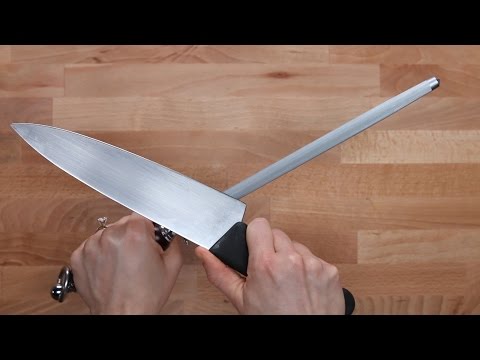
The naka-to is most likely 3000– 5000 grit and the shiage-to is most likely 7000– 10000 grit. Existing artificial grit worths range from very coarse, such as 120 grit, through incredibly great, such as 30,000 grit (less than half a micrometer abrasive particle size). [citation needed] A diamond plate is a steel plate, often mounted on a plastic or resin base, coated with diamond grit, an abrasive that will grind metal.

Diamond plates can serve many purposes including sharpening steel tools, and for preserving the flatness of man-made waterstones, which can end up being grooved or hollowed in usage. Truing (flattening a stone whose shape has actually been altered as it uses away) is extensively thought about important to the honing process however some hand sharpening methods make use of the peaks of a non-true stone.

Rubbing the diamond plate on a whetstone to real (flatten) the whetstone is a modern-day option to more conventional truing methods. Diamond plates are available in various plate sizes (from charge card to bench plate size) and grades of grit. A coarser grit is used to remove bigger quantities of metal more rapidly, such as when forming an edge or restoring a broken edge.

17 Reasons Why You Should Ignore types of sharpening stones

What Does Oil Stones Mean?

.

For those of you who are not knowledgeable about either of these kinds of whetstones, Japanese Water Stones are mined in the mountains of Japan. They are made from from ancient deposits of metamorphic stone that includes tiny silicate particles suspended in a clay matrix. As a result, the great crystals they produce when sharpening a knife blade tend to eliminate the steel very quickly while likewise polishing the surface.

They come from ancient deposits of Novaculite which is thought to be a metamorphic sandstone. Novaculite also produces great crystals when use to sharpen a knife blade and, it too, has the residential or commercial property of removing steel fairly rapidly while also polishing the surface area. Then, there are man made whetstones made from powdered, commercial grade, diamonds as well as from silicon carbide fertilized ceramic which do not need any sort of lubrication.

Indicators on Ceramic Whetstone Sharpener You Should Know

For circumstances, depending upon the kind of whetstone you are utilizing, you may initially require to lubricate it either with water or refining oil. Then, you start by comprehending the knife by the handle and putting the edge versus the whetstone at a 10 degree to 30 degree angle depending on the density of the Main Bevel and after that, gradually move the entire length of the cutting edge across the whetstone while preserving the very same angle.

Then, you continue to perform this action, rotating from side to side, up until the edge reaches the wanted sharpness. However, if you are one of the many people who has trouble maintaining a constant angle during refining, then there are numerous different types of developing help on the marketplace that will allow you to sharpen a great edge on any type of knife blade.

In addition, the right sharpening angle is identified by the relative thickness of the of the Secondary Bevel which is, in turn, governed by the kind of blade grind. Last, as a basic rule, manmade whetstones such as Crystalon and India Stones are the cheapest and work well for cutting initial, secondary, bevels or rapidly fixing harmed edges whereas, natural whetstones such as Japanese Water Stones and Arkansas Oil Stones are more expensive however, do a better task of developing, very sharp edges.

How Combination Whetstone can Save You Time, Stress, and Money.

But, no matter which kind of whet stone you choose, the genuine secret to accomplishing a super sharp cutting edge is to maintain a constant edge bevel angle throughout the whole sharpening procedure.

Numerous sushi chefs hone their valuable knives at the end of each work day. Edge life versus ease of honing – it depends on you to stabilize these factors to consider and select a proper knife. However, you should choose a knife that matches your level of honing experience and meets your needs.

As you train your knife versus the stone, you begin to individualize the edge to your particular requirements and sharpening style. With practice and great strategy, your knife ought to end up being sharper than it was in its original condition. Step 1: Soak or splash stone with water. Rough and medium stones ought to be taken in water for 10-15 minutes.

Getting My Diamond Sharpening Stones To Work

Action 2: Put the stone on wet fabric or base to support while honing. A stone base is always advantageous as it supplies clearance for your knuckles when you sharpen. It also raises the stone a little off your work surface, so you have a better, easier angle to deal with.

Start with knife pointer. Usage two or 3 fingers of left hand to press edge of blade to stone. Step 4: Keep a company grip on the knife, with shoulders square to the stone and upper body unwinded. Press edge of blade to stone and push along stone, exerting pressure as you move forward and launching pressure as you return blade to beginning position.

Once you have a burr, reverse the blade. Start with the pointer. Put in more pressure on the downward stroke and eliminate burr, or establish a double-sided edge if preferred. Japanese-Style Knives (Yanagi, Takobiki, Usuba, Kamagata Usuba, Deba Knives) Sharpen the entire cutting edge till there is a small and even burr on the reverse side.

The Basic Principles Of Oil Stones

Get rid of the burr with your middle and forefinger gently pressing the edge to the stone and your thumb gently pressing the spinal column. Pushing both sides of the blade preserves the slightly concave shape of the reverse side of the blade and assists make future sharpening possible. Consider the movement as if you are "pressing" water off the stone.

For optimal efficiency, it is really essential to protect the initial shinogi line. Western-Style Knives Keep in mind the angle of knife to stone while honing. You must also comprehend the bevel of your knife prior to honing. Angle the knife to develop the cutting edge. A 10º-20º angle is recommended. A smaller sized angle will make a sharper, however weaker cutting edge.

The EXPERT Summary: A dull knife not just makes slicing challenging, using one is harmful. If you require to hone one however you do not have a sharpener, you can use the bottom of a porcelain mug or plate. Just draw your blade down the rough part of the ceramic numerous times.

What Does Knife Sharpening Stone Do?

Thankfully, there's an inexpensive and easy fix to all of your cutting problems– even if you don't have a sharpener helpful. All you need is a porcelain mug. Draw your blade across the rough bit on the bottom numerous times in quick succession. INSIDER As Delighted sharpening!.

Japanese whetstones (likewise called water stones)– both natural and synthetic– are known for their quick-working qualities, not just for Japanese blades, however also for their Western equivalents. The little particles that do the cutting are loosely bound together in the stone, and so during sharpening with the whetstone, the surface area particles are quickly cleaned out, enabling brand-new, sharp, particles to begin working on the blade.

Introduce Yourself (Example Post)

This is an example post, originally published as part of Blogging University. Enroll in one of our ten programs, and start your blog right.

You’re going to publish a post today. Don’t worry about how your blog looks. Don’t worry if you haven’t given it a name yet, or you’re feeling overwhelmed. Just click the “New Post” button, and tell us why you’re here.

Why do this?

  • Because it gives new readers context. What are you about? Why should they read your blog?
  • Because it will help you focus you own ideas about your blog and what you’d like to do with it.

The post can be short or long, a personal intro to your life or a bloggy mission statement, a manifesto for the future or a simple outline of your the types of things you hope to publish.

To help you get started, here are a few questions:

  • Why are you blogging publicly, rather than keeping a personal journal?
  • What topics do you think you’ll write about?
  • Who would you love to connect with via your blog?
  • If you blog successfully throughout the next year, what would you hope to have accomplished?

You’re not locked into any of this; one of the wonderful things about blogs is how they constantly evolve as we learn, grow, and interact with one another — but it’s good to know where and why you started, and articulating your goals may just give you a few other post ideas.

Can’t think how to get started? Just write the first thing that pops into your head. Anne Lamott, author of a book on writing we love, says that you need to give yourself permission to write a “crappy first draft”. Anne makes a great point — just start writing, and worry about editing it later.

When you’re ready to publish, give your post three to five tags that describe your blog’s focus — writing, photography, fiction, parenting, food, cars, movies, sports, whatever. These tags will help others who care about your topics find you in the Reader. Make sure one of the tags is “zerotohero,” so other new bloggers can find you, too.

Design a site like this with WordPress.com
Get started